Reporter, Editor, Photographer
Currently Browsing: Singapore

Economic Logic Alone Does Not Make a “Home”

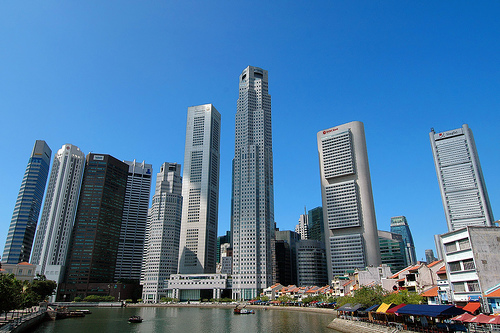
Photo: Flickr User besar bear

Photo: Flickr User besar bear

What makes a country a home? Is it emotional ties or pure economic self-interest?

Linda Lim posed this question in a Straits Times article published June 19 and it has lingered in my mind ever since, particularly at the Kent Ridge Ministerial Forum held Aug. 31 at the NUS Theatrette.

Singapore’s manpower minister, Ng Eng Hen was the minister in attendance as he suggested how the Singapore graduate can “stand tall in a shrinking world”. He talked about the perceived strengths and weaknesses of the Singapore graduate and suggested we have to improve if we were to take advantage of future opportunities in an increasingly globalised world.

It all sounded so familiar. Ng cached his argument in an unmistakable economic paradigm that has come to characterize the PAP government. But should the only logic that prevails on most occasions be economic in a home? While it is important to embrace this global human flow, is Singapore embracing this at the risk of alienating Singaporeans?

(more…)

  • Share/Bookmark

Engagement: The More, The Merrier

It is difficult to resist drawing comparisons when two apparently non-official “rescue” missions were made in the last fortnight alone by prominent U.S. political personalities. That they were to two of the world’s most closed countries — North Korea and Burma — has invited a flurry of perspectives on how the Obama adminstration should conduct themselves in its foreign policy.

Foreign Policy’s David Roftkopf advocates caution. He says:

Webb says he was not an official emissary of the administration. Bill Clinton said the same thing. Clearly, in both instances this particular bit of diplomatic kabuki theater is transparent to all. Webb is the regional subcommittee chair on a critical Senate subcommittee, he is close to the administration, was briefed by them before his trip and promises to brief them on his return. At no time did they renounce the trip and he traveled on a U.S. government plane. His visit was official and the credit for the release of Yettaw and the potential negative consequences of the mission must accrue to the president and his team.

Personally, I think making engagement a centerpiece of a new U.S. foreign policy is a major positive development for which the administration deserves great credit. But as with any such new initiative, we need to be careful about how we approach it prior to getting all the bugs worked out. The Webb mission, even with is success in terms of securing the release of Mr. Yettaw, winning a session with Suu Kyi and engaging in a rare exchange with the leader of the regime, raises important concerns that need to be addressed if the new policy is to work to our best advantage in the future.

Key to such caution will be how much the U.S. first engages with countries that wield more influence in both countries. Diplomatic pressure cannot come from America alone, it has to be multilateral and come from other countries. China figures centrally in both cases, but more so for North Korea. The Burma case is a little harder to crack because its neighbors reportedly have business interests in the country that predate the military regime in power. Economic sanctions therefore become ineffective.

Instead, the Obama administration could do better to cajole/entice Burma’s ASEAN neighbors, India and China, to apply more sustained pressure on the military junta to accede to international norms. While ASEAN member countries maintain an official non-interference stance, international outrage and the Southeast Asian regional grouping’s belated introduction of a Human Rights Mechanism in 2007 have combined to make that untenable. This is since any failure to condemn Burma’s ridiculous treatment of Aung San Suu Kyi would affect ASEAN’s credibility.

A commitment to engagement is a great starting point, but the Obama administration could expand their notion of “engagement” to take on a more pluralistic approach to advance its foreign policy agenda.

[This first appeared on TheAtlantic.com's Politics Channel.]

  • Share/Bookmark

A Glimpse of the Little Red Dot

Singapore Lights Timelapse from Weehan Yeo on Vimeo.

This beautiful visual multimedia collage of the Singapore landscape was found via @mrbrown/mrbrown.com.

  • Share/Bookmark

Replicating Singapore in China?

It was one hell of a kicker quote, but it probably summed up the appeal of Singapore’s model of governance for Chinese Communist Party cadres. “The Singapore model of development before democracy is something which suits China,” Lu Yuanli, a Chinese professor who studies Singapore, was quoted by The Straits Times to have said.

When I was back in Singapore on vacation last week, I stumbled on an article that ST carried in its print edition on June 24 about the “Singapore fever” among Chinese government officials. The full article is appended at the end of this entry, because you need to be a subscriber to access ST’s articles online.

Singapore’s system might be premised on too small a scale for China to copy its system entirely, but it can be and has been used as a template by many city officials eager to manage their own cities well. This symbiotic relationship probably started after what the same article called the “Second Wave” of Singapore “fever” after the late Deng Xiao Peng praised Singapore in the early 1990s.

There was the Suzhou-Singapore Industrial Park project that saw some hiccups a few years into its incarnation and then there is the program at Singapore’s Nanyang Technological University that according to the ST article, has trained some 16,000 Chinese city officials.

(more…)

  • Share/Bookmark

Copyright Clement Tan 2009 | All Rights Reserved | Powered by Wordpress | Designed by Elegant Themes